

Judy spent most of her career inside the conventional system, then walked away from it to practise holistically: nutrition, lifestyle, environment, and minimal drugs.
Her position is simple.
Health is the body's natural state, and the modern vet clinic has become very good at selling the opposite.
Dr. John Robb speaks up for our pets!
— Jessica Rojas 🇺🇸💪 (@catsscareme2021) February 22, 2024
Over-vaccinating and the overdosing of pet vaccines has become a global issue. 5 lbs dogs are receiving the same dose of the rabies vaccine as 150 lbs Great Danes, and vets are now witnessing terrible side effects. pic.twitter.com/qKe6l3w2jw
She's the first vet I've had on the podcast, and I appreciate her scepticism towards Big Pharma.
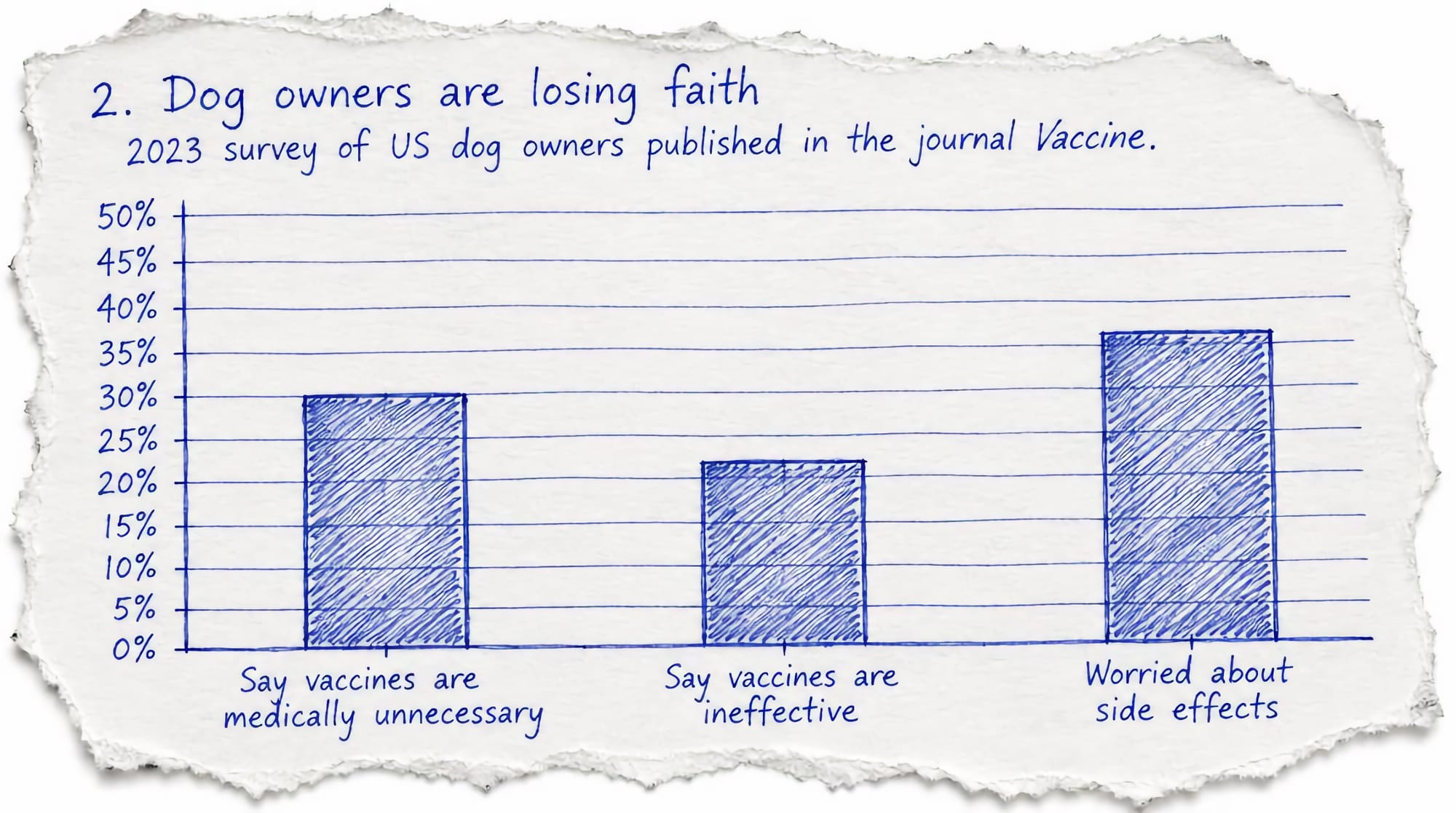
That scepticism is now a worldwide trend, thanks partly to the Covid scam, though her own paradigm shift happened years before the fake pandemic.
For the human version of the same story, listen to my many conversations found under the Viruses tag.
What Judy actually argues
Judy's case isn't complicated.
- Health is the default. An animal is supposed to be well. Disease is the exception, not the baseline.
- Pets are over-medicalised. More jabs, more drugs, more "preventative" treatments, and animals that are sicker and more chronically ill than they were a generation ago.
- Vet school is a pharma sales funnel. Students are taught that health is created by vaccines, dewormers, insecticides, antibiotics and prescription diets. Anatomy and emergency care aside, it's an induction into selling pharmaceuticals, and it works.
- The labels say "healthy animals only." Vaccines are routinely pumped into sick animals anyway.
- One dose fits all. A 5 lb Chihuahua gets the same volume of rabies vaccine as a 150 lb Great Dane.
- They're bundled. Five, seven, even nine antigens crammed into a single shot, given all at once.
- Nobody's really counting the harm. Adverse events are reported voluntarily, and the industry that profits from the needle is the same one "studying" it.
Judy doesn't go quite this far. She still thinks the jabs produce some immunity.
Podcast episode
What the data shows
But I'll humour the pharmaceutical position for a moment.
Veterinary immunologist Dr Ronald Schultz (University of Wisconsin) vaccinated around 1,000 dogs with products from every major US manufacturer and measured how long "protection" actually lasted:
- Distemper: at least 7 years by challenge, 15 years by antibody testing
- Parvovirus: at least 7 years
- Hepatitis (adenovirus): at least 7 years
- Rabies: 3 years by challenge, 7 years by antibody testing
So the entire premise of the annual booster is built on nothing, even within the pharmaceutical industry's own framework.
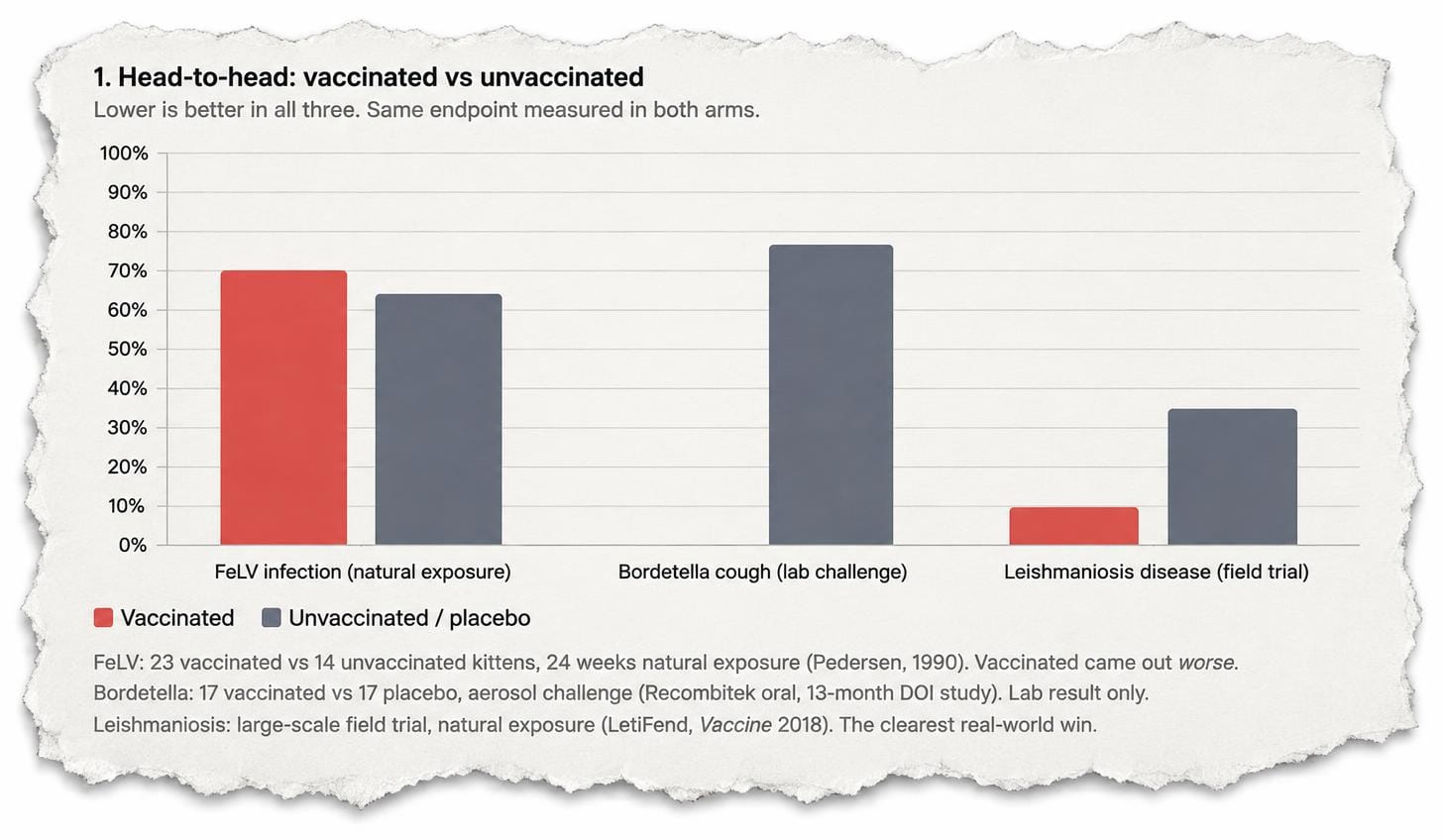
Even the industry's own body, the World Small Animal Veterinary Association, now says re-vaccinate every 3 years, and admits the science supports longer.
Vaccines do cause harm
Post-vaccination, vets have recorded:
- Cancer at the injection site in cats, known as "feline injection-site sarcoma". Studies put it at 1 to 4 cases per 10,000 vaccinated cats.
- Autoimmune haemolytic anaemia (the body destroys its own red blood cells)
- Immune-mediated thrombocytopenia (the body destroys its own platelets)
- Seizures, especially in susceptible breeds
- Autoimmune thyroiditis: vaccination triggering antibodies against the dog's own thyroid
- Polyarthritis: sudden lameness with swollen, painful joints within two weeks of a jab
- Elevated liver enzymes, kidney failure, bone marrow suppression
Adverse events are voluntary reports, and most never get filed.
The USDA, which regulates animal vaccines, keeps no public-facing database of reactions. Its own brochure admits that "good estimates of the rates of various types of adverse events are not readily available."
Even the FDA says, openly, that the reports are still underreported.
If you don't measure the harm, you get to say there's no harm.
Look inside the needle
- Many rabies vaccines still contain thimerosal, which is mercury.
- Most contain aluminium adjuvants.
- Some adjuvants are listed on the label as literally "trade secret".
"We were not educated in the potential long-term effects of vaccinations."
— Judy Jasek
Follow the money
Vet schools are funded by the pharmaceutical companies, and so is the "continuing education" vets must take to stay licensed.
Then private equity moves in.
These firms are buying up clinics at speed, and the vets inside them are paid a percentage of production, like a car salesman on commission.
They are handed production quotas. Miss the quota and some have to pay the clinic back. Bonuses are based on sales and client numbers, not on healthy outcomes.
So ask the obvious question: who benefits?
A sick animal comes back more often and gets drugs for life. An animal that never gets sick is a customer who stops paying.
And the human cost is brutal. Vets are two to four times more likely to die by suicide than the general population.
So do vaccines work at all?
My personal position is: no.
But even on their own data, they don't work the way they're sold.
The diseases were already fading. Distemper and parvo were in decline before mass vaccination, as breeding, nutrition and sanitation improved. Vaccines got the credit for a trend they didn't start.
Maybe it's all terrain. If you follow germ theory dissidents down the rabbit hole, "contagion" itself gets shaky, and "immunity" becomes a property of the body, not a needle. Judy is heading there too. She says the origin story of rabies "has no foundation".
And then there's rabies.
- Fewer than 10 Americans die of rabies a year, usually 1 to 3.
- Around 100,000 get the post-exposure shots annually.
- Yet rabies vaccination is mandatory by law, and it's the one jab you can't legally dodge.
Why?
Because, again, who benefits?
Not the pets.


