Skip to content
America did not drop atom bombs on Japan

America did not drop atom bombs on Japan

What if the evidence suggests that Hiroshima and Nagasaki were firebombed, like Tokyo and Dresden? Why has an atom bomb not been dropped since? After all, there are more powerful bombs now. Is the "nuclear threat" just a propaganda narrative?

Everyone knows that the United States nuked Japan during World War II. After all, there are books and films about it and Hollywood never lies.

What if it's a cover-up?

Atomic bombs are a grand hoax perpetuated to instill fear and maintain global control, as no real nuclear detonation has ever occurred.

— Akio Nakatani, Japanese author

What if no atomic bombs were dropped on Hiroshima and Nagasaki and, instead, the cities were firebombed, similar to Tokyo that same year? Operation Meetinghouse, as it was called, was the deadliest air raid in human history.

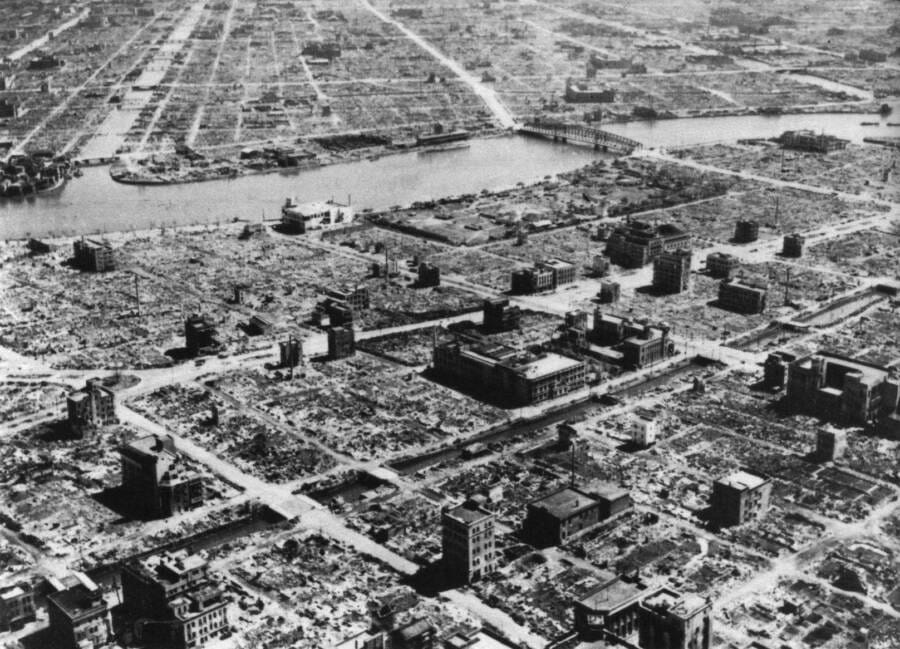
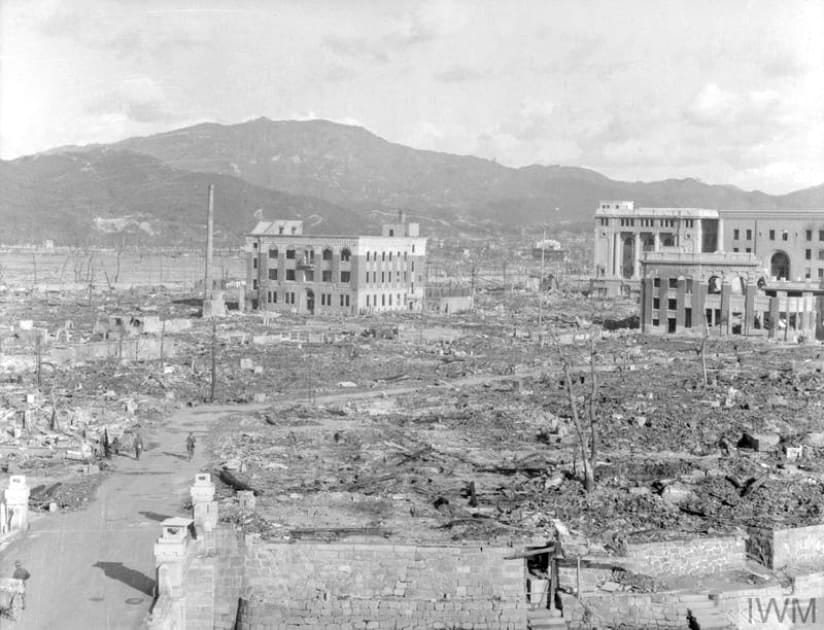
Take a look at the following photos.

The first is Tokyo after it was firebombed in 1945. Notice the concrete buildings still standing.

The second is Hiroshima after it was "nuked" in 1945. Notice the concrete buildings still standing.

Why are concrete buildings still standing?

Michael Palmer rejects the official story

Michael is a Canadian doctor who published a book, Hiroshima Revisited, in which he examines the atomic bombings of Japan and concludes that:

His book is freely available.

Hiroshima revisited : Michael Palmer : Free Download, Borrow, and Streaming : Internet Archive
The evidence that napalm and mustard gas helped fake the nuclear bombingsPrinted copies are for sale at lulu.com.A German translation is available…

The firebombing maths is damning

Here is a simple calculation that the official narrative hopes you will never do.

In May 1945, Tokyo was hit with incendiary payloads from 334 B-29 Superfortresses, burning about 41 square kilometres and destroying more than half of the city.

B-29 with a payload

The Hiroshima operation involved just about 10 square kilometres of destruction. Using the Tokyo ratio, the same result could have been achieved with roughly 83 planes, not a single magical bomb.

Hiroshima was a wooden shantytown constructed in a concentrated area. It was a sitting duck for a carefully crafted firebombing terror attack, with an atomic-bomb psyop layered on top for full effect. By the time of Hiroshima, the US Strategic Bombing Command had terror bombing and cooking civilians down to an exact science.

The ghost fleet over Imabari

Swedish engineer and nuclear expert Anders Björkman identified what may be the smoking gun.

On the exact day and hour that Hiroshima was supposedly nuked, US air command logged a fleet of 66 bombers for an operation over nearby Imabari, Japan.

The problem?

Imabari no longer existed.

It had already been wiped out in two previous raids.

So why was a fleet of 66 bombers logged for a city that was already rubble? The answer, Björkman argues, is simple: this was the fleet that firebombed Hiroshima.

Eyewitnesses describe fire

Liddell Hart's History of the Second World War claims that the Japanese on the ground didn't know they had been "A-bombed" until long after the war ended.

Think about that.

Allied occupation authorities clamped down on eyewitness testimony. The accounts that did come out often had a scripted, deceptive quality to them. The descriptions themselves could easily be describing a napalm bombing, but then suggestive phrases were inserted into the narratives, such as "strange yellow ray" and "sun ray." There are also accounts of a single B-29 flying over, but flying at about 9,750 metres, a bomber would not be visible from the ground, nor would a small fleet.

However, one eyewitness, Father John A Siemes (whose account is hosted on Yale's Avalon Project), provided more detail as to how this may have actually gone down:

It was rumored that the enemy fliers had spread an explosive and incendiary material over the city and then had created the explosion and ignition. A few maintained that they saw the planes drop a parachute which had carried something that exploded at a height of 1,000 metres. No one knew anything for certain concerning the nature of the bomb.

In the book Osada's Children of the A-Bomb, a survivor described a scene that sounds nothing like an atomic detonation:

I looked up to the sky, a streamer of smoke, perhaps 45 metres high, rising from the centre of Hiroshima, about 3 kilometres distant. At the top of the column of smoke was a ball of fire which seemed to me to be about the size of a large oil tank.

A "ball of fire the size of a large oil tank" is a firestorm, not the instantaneous flash of a nuclear weapon.

No mushroom cloud photos from the ground

Notice the conspicuous absence of mushroom cloud photographs taken from the ground in Japan.

Hiroshima photos taken by Japanese

Among the very few photos of the Hiroshima bombing that do exist, they suggest a raging firestorm, not a nuclear explosion.

Look at those photos, and then look at the beautifully epic "mushroom" photos we all know (which came from the Allies).

These firestorms were described at Hamburg in 1943, Dresden in 1945, and the various other Japanese incinerations of 1945.

The Daily Telegraph on 9 January 2013 published a newly discovered photo of the bombing that, again, resembles a firebombing and developing firestorm, not a nuclear detonation.

Major de Seversky

Perhaps the most interesting evidence comes from US Major Alexander P de Seversky, who inspected the bombed towns of Japan in 1945. He walked the ground, looked for the telltale signs of a nuclear detonation, and found none.

Here's what he said:

In Hiroshima I was prepared for radically different sights. But, to my surprise, Hiroshima looked exactly like all the other burned-out cities in Japan. There was a familiar pink blot, about three kilometres in diameter. It was dotted with charred trees and telephone poles. Only one of the city's twenty bridges was down. Hiroshima's clusters of modern buildings in the downtown section stood upright.

It was obvious that the blast could not have been so powerful as we had been led to believe. It was extensive blast rather than intensive.

I had heard of buildings instantly consumed by unprecedented heat. Yet here I saw the buildings structurally intact, and what is more, topped by undamaged flag poles, lightning rods, painted railings, air raid precaution signs and other comparatively fragile objects.

At the T-bridge, the aiming point for the atomic bomb, I looked for the "bald spot" where everything presumably had been vaporized in the twinkling of an eye. It wasn't there or anywhere else. I could find no traces of unusual phenomena.

What I did see was in substance a replica of Yokohama or Osaka, or the Tokyo suburbs, the familiar residue of an area of wood and brick houses razed by uncontrollable fire. Everywhere I saw the trunks of charred and leafless trees, burned and unburned chunks of wood. The fire had been intense enough to bend and twist steel girders and to melt glass until it ran like lava, just as in other Japanese cities.

The concrete buildings nearest to the centre of explosion, some only a few blocks from the heart of the atom blast, showed no structural damage. Even cornices, canopies and delicate exterior decorations were intact. Window glass was shattered, of course, but single-panel frames held firm; only window frames of two or more panels were bent and buckled. The blast impact therefore could not have been unusual.

To be clear, an independent US military inspector walked the ground in 1945 and said Hiroshima looked just like every other firebombed city.

Let that sink in.

The 40-year genetic study

One of the biggest red flags is a study published in the Journal of the American Medical Association in 1990.

A 40-year study of thousands of Japanese who survived the atom bombs dropped on Hiroshima and Nagasaki found that radiation exposure did not cause genetic damage that could lead to human mutations.

The researcher, John Boice of the National Cancer Institute, said:

Ionising radiation is known to cause heritable mutations in many species of plants and animals, but intense study of 70,000 offspring of atomic bomb survivors has failed to identify an increase in congenital abnormalities, cancer, chromosome aberrations or mutational blood protein changes.

70,000 offspring.

40 years of study.

Zero genetic damage.

🎙️ Podcast episode

This podcast episode includes slides. I recommend watching.

I found the following quote interesting.

'The use of [the atomic bombs] at Hiroshima and Nagasaki was of no material assistance in our war against Japan. The Japanese were already defeated and ready to surrender because of the effective sea blockade and the successful bombing with conventional weapons.'

—Admiral William D Leahy

What was the purpose of the extremely expensive Manhattan Project, then? Tokyo was firebombed and utterly destroyed in the same year but atomic bombs were dropped on Hiroshima and Nagasaki?

Nuclear weapons don't exist; the explosions were faked with conventional means, and the radiation fear is a scam to suppress free energy.

— Galen Winsor, American nuclear physicist 

Posted by

Jerm

Jerm

We’re constantly bombarded with fake news, propaganda, agendas, and outright lies. It’s an information war. What is true? I don’t know either—but I’m trying to find out.

Related episodes

What if nuclear weapons don't exist?

What if nuclear weapons don't exist?

Who is actually trying to control Africa?

Who is actually trying to control Africa?

Support me

There are several ways to support my work and help me stay independent and resilient in the face of constant censorship. Help me fight the good fight!