

Laurent Guyénot is a French author who's written some unbelievably interesting books and articles, diving into a range of controversial topics—from the history of Judaism and Christianity, to the Vatican, JFK's assassination, 9/11, and Zionism.
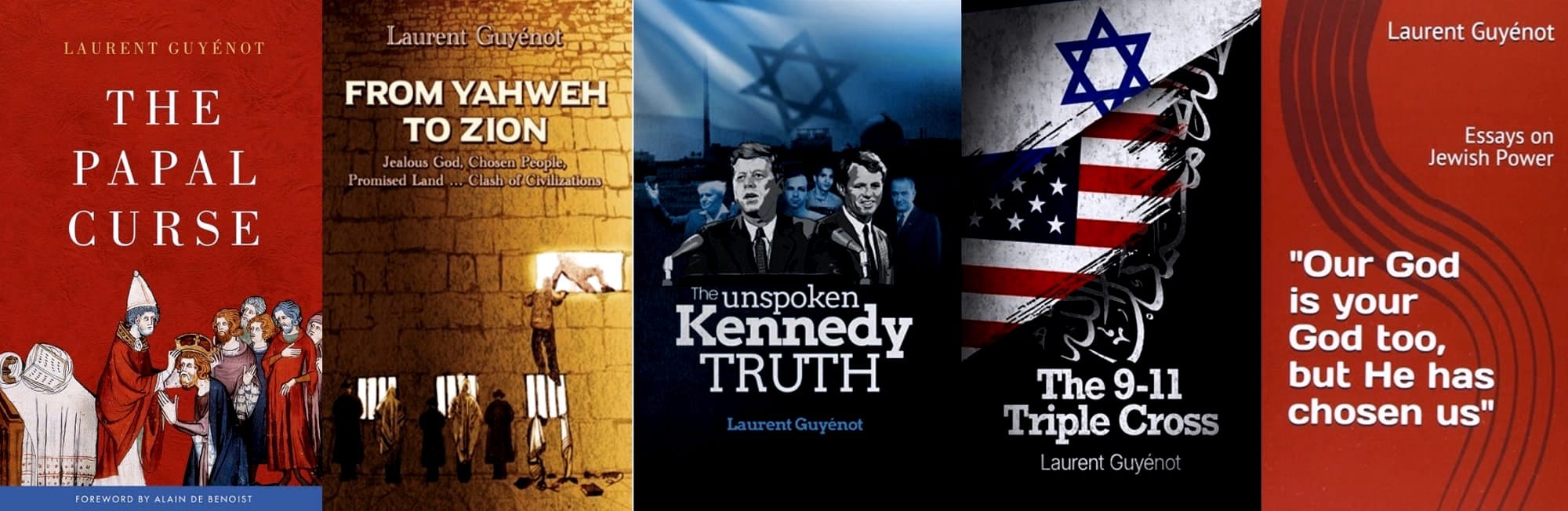
A rabbit hole that caught my attention is his breakdown of the Roman Empire and its relationship with Christianity—and why the West was founded not on Christian values, as we're often told, but on Greco-Roman ones.
There isn't a specific article I can link to, but I'd recommend checking out his Substack for a better overview of his writing.
 Laurent Guyénot
Greco-Roman West
Basically, his core thesis is that the 'Judeo-Christian' foundation of Western civilisation is a myth.
He argues that
- Greece and Rome are the West's true cultural ancestors,
- that Christianity was effectively a Jewish ideological weapon used to destabilise Rome from within, and
- that Jewish 'covenant theology' and collective identity continue to shape geopolitical conflicts today.
In other words, Western civilisation's roots are in Athens and Rome, not Jerusalem.
Laurent argues Christianity didn't win Europe on its own merits. Instead, it spread through coercive imperial power, civil wars, and the systematic destruction of Hellenic culture and knowledge.
While I learnt a lot, I don't agree with all of his claims.
However, I found this topic so extensive and fascinating that I spread it across two episodes.
Jerm
The two conversations
First one
In the first episode, Laurent makes the following arguments:
- The Torah is not primarily a spiritual text but a legal contract — a claim in God's name asserting Jewish chosenness (the 'chosen people') and primacy over other peoples, which Laurent calls the most audacious falsification in history.
- Western civilisation’s true roots are Greco-Roman, not Judeo-Christian; he uses 'Hellene' to reclaim the philosophical, scientific, and civic heritage of Athens and Rome that Christianity suppressed.
- The Jewish Wars against Rome (66–136 AD) — especially the destruction of Jerusalem in 70 AD — created a deep, enduring trauma in Jewish collective memory, which Laurent sees as a driving force behind modern Zionism.
- Christianity’s origins are deeply suspicious: how did a tribal, blood-based religion produce a universalist 'cult'? He suggests it may have been engineered as a 'virus' to undermine Roman society from within, citing its early Judaistic theology (bodily resurrection, apocalypticism).
- Constantine didn’t convert — he weaponised: after 312 AD, Christianity spread through 'state terrorism', not persuasion — imperial decrees, temple looting, financial coercion, and the Council of Nicaea’s political imposition of doctrine, not theological consensus.
Second one
In the second episode, Laurent continues with:
- The Christian civil wars (such as Arian versus Nicene) weakened Rome from within, draining military unity and making collapse inevitable.
- The Old Testament is a Trojan horse — embedded in Christianity, it carried Jewish covenant theology, chosenness ('Jews are the chosen people'), and loyalty to Israel, shaping Western identity from within.
- Jewish power comes from deep memory, not religion — figures like Netanyahu and Ben-Gurion are driven by trauma from 70 AD, not the Holocaust, seeing modern Israel as the continuation of an ancient war.
- Netanyahu reading Jews vs. Rome and saying 'we lost that battle — we must win the next' is taken literally: the war against Rome never ended.
- The West is Rome today — culturally and spiritually — and by supporting Israel unconditionally, it’s serving its own subversion.
- Christian Zionism is not a fringe movement but the logical endpoint — the Church now serves Israel, fulfilling prophecy on behalf of a foreign power.
Where to listen
Instead of watching the videos, you can listen on most podcast apps. If you use Apple Podcasts, upgrade to a paid subscription to remove the ads.
Better yet, subscribe to my premium podcast which has no ads and has exclusive, additional content.
For example, I recently spoke about my journey from censored cartoonist to censored podcaster.


